
 Oct 30, 2026 · Alice Ancona, COO, World Trade Center Miami
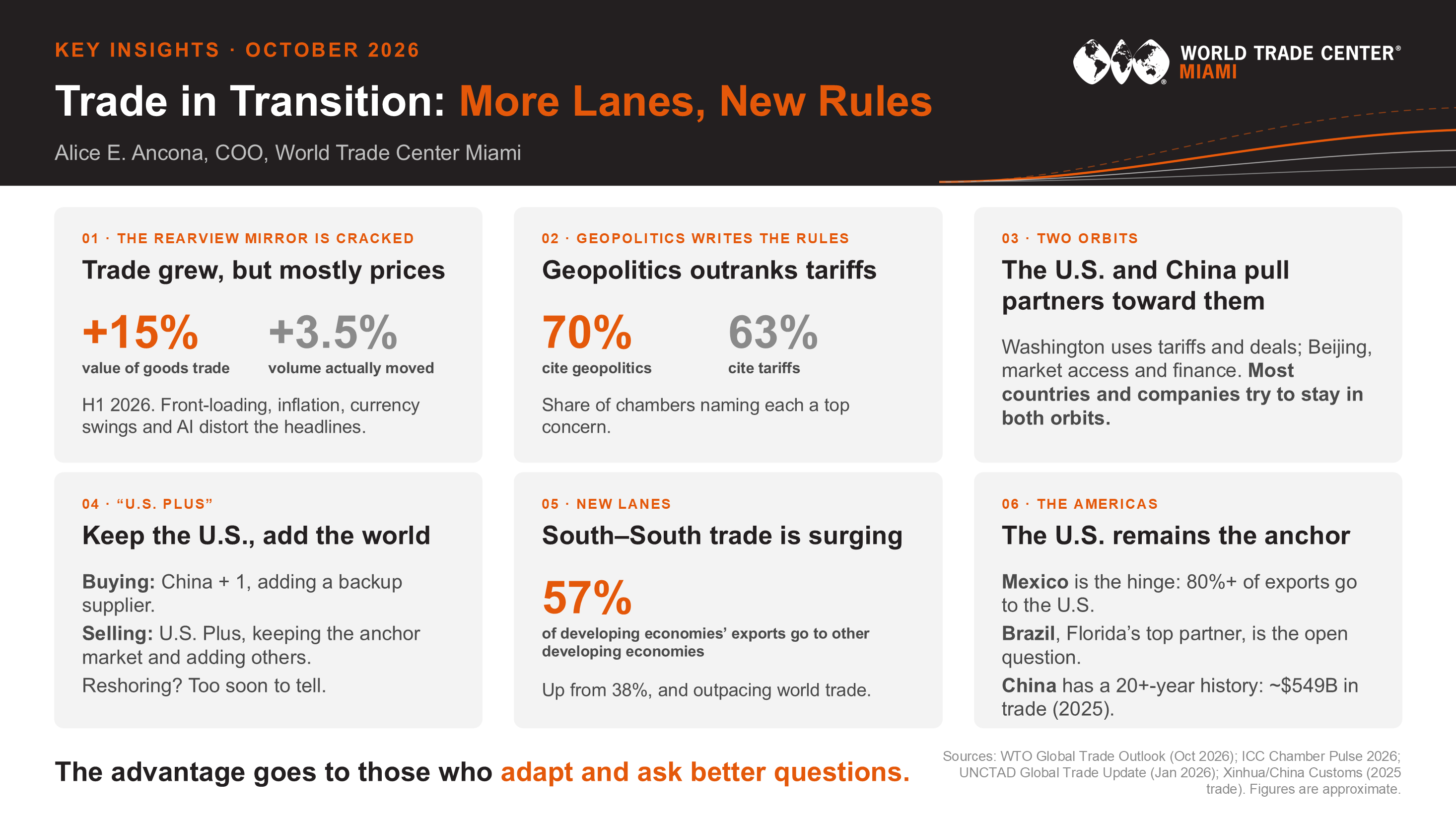
Trade is adding lanes and changing its rules, and geopolitics, more than tariffs, is writing them. The advantage now goes to those who adapt, and for the Americas and Miami, that brings as much opportunity as uncertainty.
The rearview mirror is cracked
I have worked in international trade for more than 25 years. For most of that time, reading the market followed a familiar discipline: look at multiple years of trade data, assess and rule out anomalies, find trends and new patterns, and map a strategy around a few bumps in the road. That discipline still matters, but the rearview mirror is no longer the strongest lens. Preparing the scene setter for the "Global Café: Trade in Transition" session at the 2026 World Trade Centers Association (WTCA) Member Forum made that clear: it raised more questions than answers.
Our brains, and increasingly the AI tools we use, are built to find patterns. We predict and plan by assuming the future will rhyme with the past. When the patterns aren't there, how do you predict and plan?
Start with the benchmark. 2025 is not a normal year to compare against, and 2026 isn't shaping up to be one either. Companies rushed imports in early to get ahead of U.S. tariffs, so by that metric alone, almost any comparison with 2026 is distorted. Depending on the month, 2025 can look like a boom and 2026 like a slump, or the reverse. And this year brings its own distortions: the AI buildout, conflict in the Middle East, and a U.S. tariff regime rewritten mid-year.
Then add inflation. When energy, freight, and component prices rise, trade value climbs even if no more goods are moving. Is trade growing, or are prices? The answer is both, but mostly prices. In the first half of 2026, according to the WTO, the value of world goods trade rose about 15%, while the volume of goods that actually moved rose only about 3.5%. Currency swings add another layer, because global trade is counted in dollars. The dollar weakened into early 2026, then strengthened from mid-year. Depending on the period you compare, that can flatten the numbers or shrink them.
Then add artificial intelligence. The global buildout of chips, servers, and data-center equipment is so large that it lifts the headline totals on its own. The World Trade Organization expects goods trade to grow 3.9% in 2026. By my rough estimates, take AI-related goods out and growth is closer to flat. Most businesses are living in that flatter world, not the headline one.
The headline numbers can mislead, but once you set the distortions aside, the picture is clearer. So this piece is less about the numbers than about the forces behind them. Trade isn't shrinking, and it isn't being rerouted. It's adding lanes and getting more complex. Diversification and resilience now matter more than just-in-time efficiency, and the forces shaping those new lanes are increasingly political. Where I do use numbers below, read them as direction rather than precision. Where possible, I’ve leaned on long-term trends and relative measures rather than year-on-year swings.
Geopolitics, not tariffs, is in the driver's seat
Tariffs dominate the headlines, but globally, they are no longer the top business concern. In the International Chamber of Commerce's 2026 survey of more than 350 chambers worldwide, 70% named geopolitical tensions as a top concern, ahead of tariffs at 63%. That matches what I hear. For companies trading directly with the U.S., though, tariffs remain the most immediate pressure.
Tariffs have become an instrument of geopolitics: more a symptom than the cause, and an unstable one. In a single year, the legal basis for U.S. tariffs changed three times: the Supreme Court struck down the broadest tariffs, a temporary replacement expired, and a new set took their place. The rate matters, but so does the uncertainty about what comes next.
Meanwhile, conflict is adding friction directly. The Strait of Hormuz has been largely closed to normal shipping since early 2026, pushing up the cost of energy, fertilizer, freight, and insurance far from the Gulf.
And governments are choosing partners through a geopolitical lens. Trade agreements that had stalled for years were suddenly concluded or signed after the 2025 U.S. tariffs: the EU with India after 19 years of talks, with Mercosur after more than 25, and the UK with the Gulf states. Is timing a coincidence or strategic? Canada is now exploring a first-of-its-kind "associate" relationship with the European Union. Canadian exporters are already looking further afield: in a recent survey by customs broker Livingston International, 82% named Asia and 58% the EU and UK as alternative markets. Companies now ask not only "what does it cost?" but "who can I count on?"
For several years, the U.S. and China have acted like two massive celestial bodies, each exerting its own gravitational pull on trading partners and using different tools. Washington uses tariffs and bilateral deals to press partners to choose. Beijing uses market access and finance: since May 2026, it has offered zero-tariff treatment to all 53 African countries with which it has relations, extended in July to 63 countries, on top of two decades of loans and investment. Countries and companies are trying to stay in both orbits rather than choose one, with varying success.
Some of the fastest-growing lanes aren't pulled into either orbit. Trade among developing economies, so-called South–South trade, has grown from about $0.5 trillion in 1995 to $6.8 trillion in 2025, according to UNCTAD. More than half of developing economies' goods exports, 57%, now go to other developing economies, up from 38%. This growth is faster than world trade as a whole, and much of it is anchored in Asia's regional supply chains.
Keep the U.S., add the world: the rise of "U.S. Plus"
Despite the friction, companies are not walking away from the U.S. market. It is still the world's largest consumer market, and no one can afford to ignore it. They are keeping the U.S. and adding more markets alongside it. I’ll use "U.S. Plus" for lack of a better term. The ICC survey points to the same trend: most businesses are diversifying markets and suppliers, while relocating production is losing ground.
It helps to separate buying from selling:
- When companies buy, it's "China + 1." Many keep their Chinese suppliers and add one more country as a backup. Research shows businesses usually shift to one main replacement, often a country already tied into Chinese supply chains.
- When companies sell, it's "U.S. Plus." Exporters keep the U.S. as their anchor and add Europe, Asia, or Latin America so they depend less on one customer.
Three reality checks. First, China + 1 moves the U.S. trade deficit more than it closes it. As the U.S. deficit with China has shrunk over the past several years, the deficit with Vietnam has grown, and it is now the largest of any country. To be fair, supporters of current policy point to early results: U.S. goods exports grew about 15% in the first half of 2026, and the overall U.S. trade deficit is down about 20% so far this year. Some of that reflects the unwinding of the 2025 import rush, so it is too early to call it a trend.
Second, it is too soon to tell how much production is truly returning to the U.S. Of the new foreign investment in the U.S. in 2025, 94% was acquisitions of existing companies, not new factories. Nearshoring to Mexico is real, but it is being led by companies already there: most of Mexico's record foreign investment in 2026 is reinvested earnings, not new arrivals. The shift is happening. It is slower and more incremental than the announcements suggest. The same Livingston survey found 77% of U.S. businesses pausing investment in North American supply chains until there is more stability.
Third, the U.S. is the anchor for trade that faces the U.S. For much of Asia and Africa, China plays that role, and trade among other countries is growing faster than trade with either. In the Americas, the U.S. remains the anchor. Globally, it increasingly shares the stage.
AI is an ecosystem, and services are America's quiet advantage
AI trade is genuinely new, and it distorts markets massively. It is also bigger than the hardware. Chips, servers, and cooling equipment are only the visible part. Around it sits an ecosystem of cloud services, software, engineering, financing, and data-center investment that trades too, much of it as services.
Much of today's AI trade is the buildout itself: the data centers, chips, and power equipment being installed right now. AI is here to stay, and more buildout cycles will follow as equipment ages and technology advances. But the urgency, pace, and cost of this first wave are unlikely to be repeated in the same way. Over time, AI will become a permanent part of what we trade, and less of a distortion.
Policy treats AI differently as well. Most AI-related imports into the U.S. are exempt from tariffs, so they face an effective rate of about 4.5%, against about 12% for everything else, according to the Federal Reserve Bank of Minneapolis. The AI trade boom is driven by the buildout and, in part, by that shielding. The rest of the economy is far less protected: non-AI goods face nearly three times the effective tariff rate, even if exemptions, such as those for trade that qualifies under USMCA, soften the blow for some.
That brings me to services, the part of trade that rarely makes the headlines. You cannot export or import anything without a service attached: shipping, insurance, finance, software, legal, and logistics. The U.S. is the world's leading exporter of services, and services have long offset a large share of the goods deficit. Globally, services trade has slowed this year, largely because the Middle East conflict has hit travel and transport. U.S. services have held up: they kept growing in 2026 while global services slowed, led by intellectual property, financial, and digital services, and the services surplus, about $340 billion in 2025, offset more than a third of the goods deficit.
The key question is whether that advantage stays insulated. Disputes over digital taxes and data rules, and this year's lapse of a long-standing global pause on duties for digital transmissions, could bring services into the trade fight.
The Americas: a political window meets economic realities
A window worth watching
Not long ago, much of Latin America was looking increasingly toward China, and U.S. trade with the region was losing ground. That was a particular concern for Florida: 12 of the 20 countries with a U.S. free trade agreement are in the Americas, and most of Florida's top trading partners are among them.
Since 2023, elections in Argentina, Ecuador, Panama, Bolivia, Chile, Honduras, Costa Rica, Colombia, and Peru have brought governments that have signaled closer ties with Washington. Several U.S. ambassadors in the region, including to Mexico, Panama, Peru, and Argentina, also have strong Florida roots or ties.
Miami has been the region's gateway and exchange point for decades, regardless of who governs, and our relationships were strong before this cycle. Political alignment is also not the same as trade alignment. Economic realities tend to outlast elections: the U.S. share of South America's trade has slipped since 2000 under governments of every stripe. The window is real. Turning relationships and goodwill into trade and investment is the work.
China’s presence in the region is not new, and it is not only political. China engaged Latin America in trade more than 20 years ago, bringing not just an appetite for soybeans, copper, and oil but also investment and financing the region needed. Today, the focus is shifting to critical minerals: lithium in Argentina, Bolivia, and Chile; copper in Peru and Chile; and rare earths in Brazil, which holds the world’s second-largest reserves. Chinese firms now hold mining interests in a dozen countries in the region, and because China leads the refining of nearly every strategic mineral, much of what the region mines ends up processed in China. That has made Latin America’s minerals a new front in U.S.–China competition. In 2000, China bought less than 2% of Latin America’s exports; today it is South America’s largest trading partner, with trade reaching about $549 billion in 2025 in dollar terms, and Brazil alone accounted for nearly half of China’s purchases from the region. The flow has also tipped the other way: Chinese exports, from cars to e-commerce parcels, now outpace the region’s sales to China, leaving Latin America with a trade deficit of about $46 billion.
Beijing's approach is evolving too. After lending more than $120 billion to the region since 2005, it is moving away from large loans and megaprojects toward more selective investment tied to its own industries, while Chinese-built infrastructure such as Peru's Chancay port opens more direct routes to Asia. Over the same period, U.S. attention was often focused elsewhere. The lesson for all of us, Miami included: others fill the void in relationships we don't tend to. As my grandmother would often remind me, “Ojos que no ven, corazón que no siente”. (Roughly: “out of sight, out of mind.”)
Mexico: the hinge
Mexico shows both the promise and the limits of diversification. More than 80% of its exports go to the U.S., yet it imports more and more from China, Southeast Asia, and Taiwan. It has quietly become one of the largest suppliers of AI-related equipment to the U.S. With USMCA now under annual review, the rules for that trade are being renegotiated. Geography and integration remain Mexico's and North America's biggest competitive advantage. Most of Mexico’s trade with the U.S., about 85% by value, moves overland by truck and rail, with the Laredo, Texas crossing alone handling about 40%. Mexico’s trade with Asia and Europe largely moves through its own seaports. Florida plays a small role, particularly in air cargo and re-exports, but it still needs to build those links.
Brazil: Florida's biggest partner, and an open question
Brazil is Florida's largest trading partner, and it has no free trade agreement with the U.S. President Lula's recent re-election points to continued friction with Washington and a Brazil that trades with all sides, including China. U.S. tariffs remain in play, and so does the possibility of Brazilian retaliation. At the same time, the EU–Mercosur agreement has begun to give European exporters preferential access to Brazil. Something U.S. exporters do not have.
It is too soon to tell what that means for Florida. The EU has its own challenges. European companies are no strangers to Brazil and Mexico, but both are complex markets, especially for smaller and first-time exporters. Miami’s decades of relationships, proximity, connectivity, and bilingual, on-the-ground experience, along with a U.S. legal and financial platform, are advantages that can offset a tariff preference, for now. But price, scale, preferential access, and more direct connections can claw some of that back. This is one to watch, not take for granted.
Miami: the exchange point
As I wrote earlier this year, Miami is not just an endpoint for trade; it is where trade is exchanged. Re-exports, aircraft maintenance and repair, free trade zones, logistics and finance make the city a platform that adapts as routes change. As trade adds lanes, that adaptability matters more than any single election or agreement. But continuity is earned, not guaranteed. Over time, increased direct shipping between Asia and South America, new trade lanes, new ports, and competing gateways could carve out Miami. Miami cannot afford to be complacent.
If the data is distorted, how should a business plan?
- Read signals, not snapshots. Data still matters but look beyond 2025. Look at volumes as well as values. Data needs context; it also needs more lenses to distinguish growth from higher prices.
- Plan for scenarios, not a forecast. The Strait of Hormuz, the USMCA review, court rulings on tariffs, and the AI investment cycle could each move in either direction.
- Adapt and adjust. Add markets deliberately, starting where trade agreements already give you an advantage. Watch for new trade lanes.
- Invest in compliance. Rules of origin are tightening. It's not just tariffs; customs regulations are being reviewed and overhauled globally. The "paperwork" is a very real competitive edge. In the Livingston survey, 77% of U.S. importers and exporters said they could not confirm full compliance with recent trade and tariff changes.
- Use your networks. Relationships, local knowledge, and trusted partners are worth more when the map keeps moving.
The road is getting wider and busier faster than the data can capture it. That unsettles anyone who plans by the numbers. But more lanes also mean more openings, especially for those with relationships and experience to navigate them. That has always been the World Trade Center network's strength, and Miami's. The lanes have multiplied, and the rules have changed. In the Americas, the U.S. remains the anchor. The advantage now goes to those who adapt and ask better questions.
Sources
- World Trade Organization, Global Trade Outlook, Oct 2026
- International Chamber of Commerce, Chamber Pulse 2026
- Minneapolis Fed, trade in AI-related goods (May 2026)
- BEA, U.S. International Trade in Goods and Services, Aug 2026
- Mexico Business News, Mexico's record foreign investment, H1 2026
- SelectFlorida, Florida's top trading partners
- Trade.gov, U.S. free trade agreement partners
- CBC News, Canada–EU associate membership (27 Oct 2026)
- WTC Miami, Miami's trade data tells a different story
- WTC Miami briefing slides on foreign investment, reshoring and services trade (Aug 2026), based on BEA and Census data
- Council on Foreign Relations, China's influence in Latin America
- People's Daily, China extends zero-tariff treatment to 63 countries (Jul 2026)
- UNCTAD, Global Trade Update, January 2026 (summary via AJOT)
- Atlantic Council, The rewiring of globalization is under way (Oct 2026)
- Americas Quarterly, China is raising the stakes in Latin America (Oct 2026)
- Xinhua via Qiushi, China–Latin America trade in 2025 (Feb 2026)
- South China Morning Post, China's trade with South America and Peru's port
- Council on Foreign Relations, China–Latin America, August 2025
- Livingston International, 2026 Trade Dynamics Report (press release, Oct 29, 2026): prnewswire.com
- Diálogo Américas, China expands its grip on Latin America’s strategic minerals (Aug 2026)
- FIU Security Research Hub, China’s dominance in LAC’s critical mineral sector
- Business Standard, Lula wins record fourth term (Brazil’s rare earth reserves)
- Latin Times, Brazil’s runoff and critical minerals
- Bureau of Transportation Statistics, Transborder Freight Data Annual Report 2025